

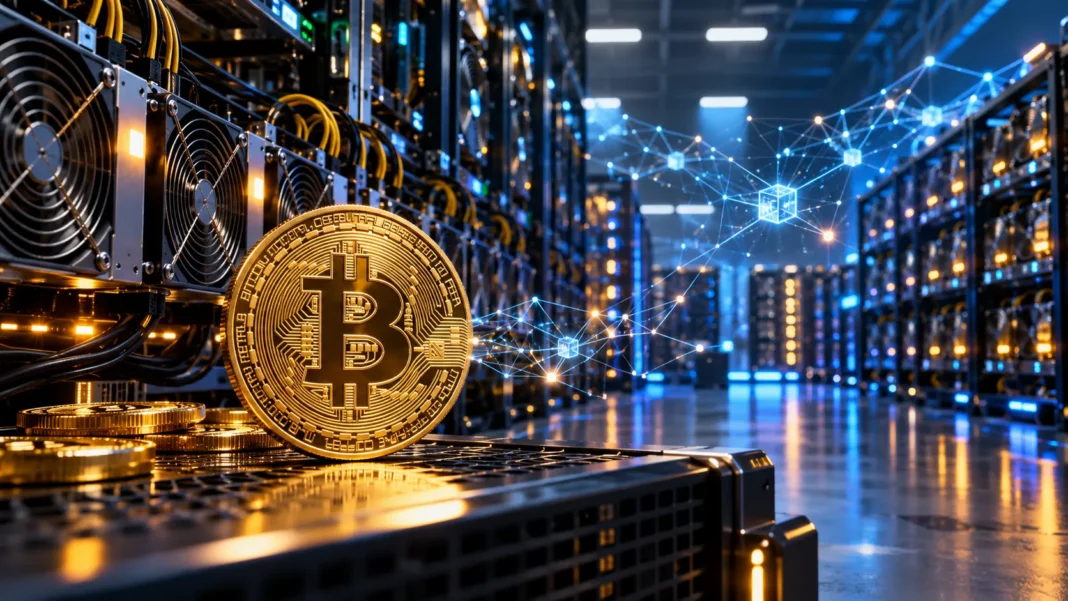

Bitcoin mining is one of the most important processes supporting the Bitcoin network. It helps verify transactions, secure the blockchain, and introduce new bitcoins into circulation according to predetermined rules. However, many beginners find the concept confusing because it involves specialized computers, mathematical calculations, electricity consumption, and digital currency technology. Understanding the fundamentals can make this complex process easier to follow.
If you have ever wondered what Bitcoin mining is and how it works, the answer begins with understanding blockchain technology and the role of miners. Unlike traditional banking systems, Bitcoin operates through a decentralized network without a central authority controlling transaction verification. This guide explains the Bitcoin mining process, mining equipment, rewards, environmental impact, and important considerations for anyone interested in cryptocurrency technology.
What Is Bitcoin Mining?
Bitcoin mining is the process of using specialized computing equipment to compete for the opportunity to add a new block of transactions to the Bitcoin blockchain. Miners perform repeated cryptographic calculations to find a valid result that satisfies the network’s requirements. The successful miner can propose a new block and receive a reward if the block is accepted.
The term mining is used because the process introduces new bitcoins into circulation, somewhat like extracting valuable resources from the ground. However, Bitcoin mining does not involve physically discovering digital coins. Instead, new bitcoins are created through a predefined reward mechanism. This system connects cryptocurrency issuance with the work required to maintain blockchain security.
Bitcoin mining also performs an essential security function by making it computationally expensive to rewrite confirmed transaction history. Miners compete to extend the blockchain, while independently operated network nodes verify that proposed blocks follow Bitcoin’s rules. This combination supports the decentralized network. Mining therefore serves two connected purposes: facilitating block creation and helping protect transaction records.
How Does Bitcoin Mining Work?
Bitcoin mining begins when users broadcast transactions to the network. Nodes examine these transactions and determine whether they satisfy the relevant rules, including whether the digital signatures are valid and the funds can be spent. Miners then select eligible transactions for potential inclusion in a new block. They commonly prioritize transactions offering higher fees relative to their data size.
After assembling a candidate block, mining equipment repeatedly calculates cryptographic hashes while changing permitted block data. The objective is to find a block header hash below the current network target. This process is called proof of work because producing a valid result requires substantial computational effort. Finding the result involves repeated attempts rather than solving an ordinary mathematical equation.
When a miner discovers a qualifying hash, the proposed block is broadcast to the Bitcoin network. Other nodes independently check its transactions, structure, and proof of work before accepting it. If valid, the block may become part of the chain that nodes recognize as having the most accumulated work. The process then repeats as miners compete to construct subsequent blocks.
Why Is Bitcoin Mining Important for Blockchain Security?
Bitcoin mining contributes to security by making changes to recorded transaction history increasingly expensive. Every valid block contains a reference to the previous block, creating a connected sequence of transaction records. Altering an earlier block would invalidate the proof of work built upon it. An attacker would need to recreate that work and compete against the honest network.
This security mechanism helps protect Bitcoin against double-spending attacks. Double spending occurs when someone attempts to use the same bitcoin in conflicting transactions. Blockchain confirmations make successfully reversing an accepted payment progressively more difficult as additional blocks accumulate. However, no number of confirmations provides an absolute guarantee against every conceivable attack or network disruption.
Independent validation is another important part of Bitcoin’s security model. Miners cannot simply introduce invalid transactions or create unlimited bitcoins because network nodes enforce the protocol’s rules. A block that violates those rules is rejected by properly validating nodes. Understanding this distinction helps explain why Bitcoin relies on both computational mining and decentralized transaction verification.
What Is Proof of Work in Bitcoin Mining?
Proof of work is the consensus mechanism Bitcoin uses to make block production computationally demanding. Miners must find a hash that satisfies a difficulty target established by the network’s rules. Although checking a successful result is relatively straightforward, discovering one generally requires many attempts. This difference between difficult production and efficient verification is central to the system.
Bitcoin mining uses the SHA-256 cryptographic hash function as part of its proof-of-work calculation. A hash function transforms input data into a fixed-length output that appears unpredictable. Miners repeatedly adjust eligible values and calculate new hashes in search of a qualifying result. Faster mining equipment can perform more attempts, increasing the likelihood of finding a block.
Proof of work also helps determine how competing versions of transaction history are resolved. Nodes following Bitcoin’s consensus rules generally select the valid chain with the greatest cumulative proof of work. This makes rewriting history costly, particularly when considerable mining power supports the network. However, the mechanism requires significant computing resources and electrical energy.
What Equipment Is Used for Bitcoin Mining?
Bitcoin mining originally began with ordinary computer processors when the network was relatively small. As competition increased, miners adopted graphics processing units and later more specialized technologies. Today, competitive Bitcoin mining relies predominantly on application-specific integrated circuits, commonly called ASICs. These devices are designed to perform the hashing calculations required by Bitcoin’s proof-of-work system.
ASIC miners differ from ordinary computers because they are optimized for a narrow computational purpose. Their efficiency is commonly evaluated by comparing computing performance with electrical consumption. More efficient equipment can perform additional hashing work for the same amount of energy. However, specialized mining hardware may be expensive, generate considerable heat, and require ongoing maintenance.
Mining operations also depend on supporting infrastructure beyond computing equipment. Power supplies, cooling systems, network connections, and suitable electrical installations are important components. Larger facilities may use industrial ventilation or specialized cooling technologies to manage equipment temperatures. These practical requirements explain why Bitcoin mining involves much more than simply running software on a personal computer.
What Is Bitcoin Hash Rate and Mining Difficulty?
Hash rate refers to the number of cryptographic hash calculations mining equipment can perform within a given period. It is commonly measured in hashes per second, with larger units used for powerful mining systems and the entire Bitcoin network. Greater hash rate means more attempts to discover a qualifying block hash. However, it does not guarantee that an individual miner will receive a reward.
Mining difficulty determines how challenging it is to find a valid block compared with a reference target. Bitcoin automatically adjusts this difficulty approximately every 2,016 blocks to maintain an average block interval of ten minutes. If mining power increases substantially, difficulty generally rises. If mining power decreases, difficulty can fall after an adjustment.
These mechanisms help Bitcoin operate without a central authority scheduling new blocks. Individual blocks may be discovered seconds apart or take considerably longer because mining involves probability. The ten-minute interval represents a long-term target rather than a fixed timetable. Understanding hash rate and difficulty helps explain why increasing computing power does not automatically produce proportionally more network-wide rewards.
How Do Bitcoin Miners Earn Rewards?
Bitcoin miners receive economic incentives for successfully producing valid blocks. These incentives consist of newly created bitcoins, known as the block subsidy, and transaction fees associated with the included transactions. The reward is claimed through a special transaction within the block. Network nodes verify that this transaction does not exceed the amount permitted by Bitcoin’s consensus rules.
Following the April 2024 halving, the Bitcoin block subsidy became 3.125 BTC per block. This subsidy is scheduled to decrease again after another 210,000 blocks, with the next halving expected around 2028. Transaction fees vary depending on the payments included in each block. Consequently, total mining rewards are not identical across every successful block.
Receiving a mining reward does not automatically mean an operation is profitable. Mining equipment consumes electricity and may require substantial spending on cooling, maintenance, and infrastructure. Bitcoin’s market price can also change significantly over time. These factors make financial outcomes uncertain, particularly when operational expenses exceed the value of rewards.
What Is the Difference Between Solo and Pool Mining?
Solo mining involves independently competing to discover valid Bitcoin blocks. An individual miner or mining operation attempts to find a qualifying hash without combining its hashing power with other participants for reward distribution. If the miner successfully produces an accepted block, it can claim the permitted reward. However, finding blocks independently is highly unpredictable.
Pool mining involves multiple participants combining their computing resources through a coordinated mining arrangement. When the pool discovers a valid block, rewards are distributed according to its established terms and participating miners’ contributions. This arrangement can provide more frequent, smaller payouts than independent mining. Pool operators may also charge fees and apply different payout policies.
The distinction between solo and pool mining illustrates how computational competition affects reward distribution. Independent operations face greater variability in when rewards may arrive, while pools distribute earnings across participants. Neither approach removes equipment costs, electricity consumption, or financial uncertainty. Both remain subject to Bitcoin’s consensus rules and the network’s overall mining difficulty.
What Is Bitcoin Halving and Why Does It Matter?
Bitcoin halving is a programmed event that reduces the block subsidy by approximately fifty percent. It occurs every 210,000 blocks, corresponding to roughly four years at Bitcoin’s targeted block production rate. The mechanism was introduced to control the issuance of new bitcoins. It operates through protocol rules rather than decisions made by a central financial institution.
When Bitcoin launched in 2009, the initial block subsidy was 50 BTC. Subsequent halvings reduced it to 25, 12.5, 6.25, and eventually 3.125 BTC in April 2024. This predictable reduction gradually slows the introduction of additional bitcoins. The schedule supports Bitcoin’s maximum supply of approximately 21 million coins.
Halving also influences the economics of Bitcoin mining because miners receive fewer newly issued coins for each successful block. Their financial outcomes depend on transaction fees, market prices, operational costs, and mining competition. As subsidies decrease, transaction fees may become increasingly important. However, future mining profitability and Bitcoin market prices cannot be predicted reliably.
How Much Electricity Does Bitcoin Mining Consume?
Bitcoin mining requires electricity because specialized computers continuously perform cryptographic calculations. The total amount consumed depends on the number of active machines, their efficiency, and operating conditions. Large mining facilities may require substantial electrical infrastructure and cooling equipment. Energy use is therefore an important consideration when evaluating the broader effects of Bitcoin’s proof-of-work system.
The environmental impact of mining depends partly on how the electricity is generated. Operations powered by fossil fuels can contribute to greenhouse gas emissions, while those using lower-carbon electricity may have a different emissions profile. Hardware manufacturing and disposal also create environmental concerns. Measuring the complete impact requires considering energy sources, equipment lifespans, and local conditions.
Some mining companies explore renewable energy, waste heat recovery, and more efficient cooling technologies. Others operate in locations where electricity costs or available energy resources influence their business decisions. These approaches may reduce certain impacts but do not eliminate energy consumption. Understanding these tradeoffs helps readers evaluate Bitcoin mining beyond its financial and technological characteristics.
Is Bitcoin Mining Profitable?
Bitcoin mining profitability depends on several variables rather than a guaranteed earning formula. Important factors include electricity costs, hardware efficiency, Bitcoin’s market price, network difficulty, and equipment depreciation. A mining operation may generate rewards while still losing money after expenses. Understanding the difference between revenue and profit is essential when examining mining economics.
Competition also influences financial outcomes because miners collectively compete for a limited number of block rewards. When more computing power joins the network, individual participants may face greater difficulty earning a share of those rewards. Hardware can become less competitive as technology improves. Maintenance costs, downtime, and changing market conditions introduce additional uncertainty.
Claims promising guaranteed mining profits should therefore be treated skeptically. Some online promotions exaggerate possible earnings or fail to explain operating expenses and financial risks. Cryptocurrency prices are volatile, and mining rewards are not dependable personal income. Learning how the technology works is different from assuming that operating mining equipment will produce a financial benefit.
What Are the Biggest Challenges of Bitcoin Mining?
One major challenge involves the intense computational competition required to discover valid blocks. Specialized equipment can become outdated as more efficient technology enters the market. Mining difficulty also changes in response to the network’s overall computing power. These conditions make it challenging to evaluate long-term performance using only current hardware specifications or historical rewards.
Another challenge involves maintaining reliable physical infrastructure. Mining hardware produces heat, requires electrical power, and can generate considerable noise. Equipment failures and operational interruptions may affect performance. Environmental concerns and local regulations can also influence where commercial mining facilities operate. These practical issues demonstrate that mining is an industrial computing activity rather than simply a digital transaction process.
Financial uncertainty presents an additional challenge because the value of Bitcoin changes independently of mining expenses. Electricity contracts, maintenance requirements, and equipment investments may remain costly even when cryptocurrency prices decline. Regulatory requirements also vary by location and may change. Anyone studying the industry should distinguish between its technical operation and the risks of commercial participation.
What Is the Future of Bitcoin Mining?
The future of Bitcoin mining will likely be influenced by hardware innovation, energy costs, regulation, and Bitcoin’s economic incentives. More efficient computing equipment could change the relationship between hashing performance and electricity consumption. Mining operations may also continue exploring different energy sources and cooling systems. However, technological improvements do not eliminate the fundamental computational requirements of proof of work.
Bitcoin’s issuance schedule is another important long-term consideration. Block subsidies will continue decreasing approximately every four years until new issuance eventually approaches zero, around the year 2140. Transaction fees are expected to become the remaining direct compensation for miners. Whether those fees will consistently support a particular level of mining activity remains uncertain.
Decentralization will continue to be an important topic in discussions about Bitcoin’s future. The distribution of mining power across operators, pools, and geographic regions can affect concerns about network concentration. Developers, researchers, and industry participants continue examining these issues. Understanding the future of mining requires considering security, economics, technological development, and environmental sustainability together.
Conclusion
Bitcoin mining is the process through which specialized computers compete to produce new blocks and help secure the Bitcoin blockchain. Using proof of work, miners perform repeated cryptographic calculations while network nodes independently verify the resulting blocks. This system allows Bitcoin to maintain a shared transaction history without relying on a central authority.
Understanding how Bitcoin mining works also requires familiarity with mining difficulty, hash rate, rewards, and halving events. These mechanisms influence how blocks are created and how new bitcoins enter circulation. However, mining involves substantial energy consumption, specialized technology, and financial uncertainty. Its technical importance does not guarantee that participation will be profitable.
Ultimately, Bitcoin mining represents a distinctive combination of cryptography, distributed computing, and economic incentives. As the network develops, questions about energy efficiency, decentralization, and long-term miner compensation will remain important. Learning these fundamentals provides a useful foundation for understanding Bitcoin and the broader development of blockchain technology.
Frequently Asked Questions
What is Bitcoin mining in simple words?
Bitcoin mining is the process of using specialized computers to compete to add valid transaction blocks to the blockchain. It helps secure the network and distributes new bitcoins through programmed rewards.
How long does it take to mine one Bitcoin?
Bitcoin targets approximately one new block every ten minutes, but each block currently provides a 3.125 BTC subsidy. Individual miners do not receive bitcoins at a predictable rate, and rewards depend on mining circumstances.
Can Bitcoin mining be done on a normal computer?
Ordinary computers can technically perform Bitcoin hashing calculations, but modern mining competition is dominated by specialized ASIC equipment. Consumer computers are generally not competitive for earning meaningful mining rewards.
How many bitcoins can ever exist?
Bitcoin’s programmed issuance schedule limits the total supply to approximately 21 million bitcoins. New issuance decreases through periodic halvings and is expected to effectively end around the year 2140.
What happens when all bitcoins are mined?
When new Bitcoin issuance eventually ends, miners will no longer receive newly created coins as block subsidies. They can continue receiving transaction fees for producing valid blocks and supporting network security.