

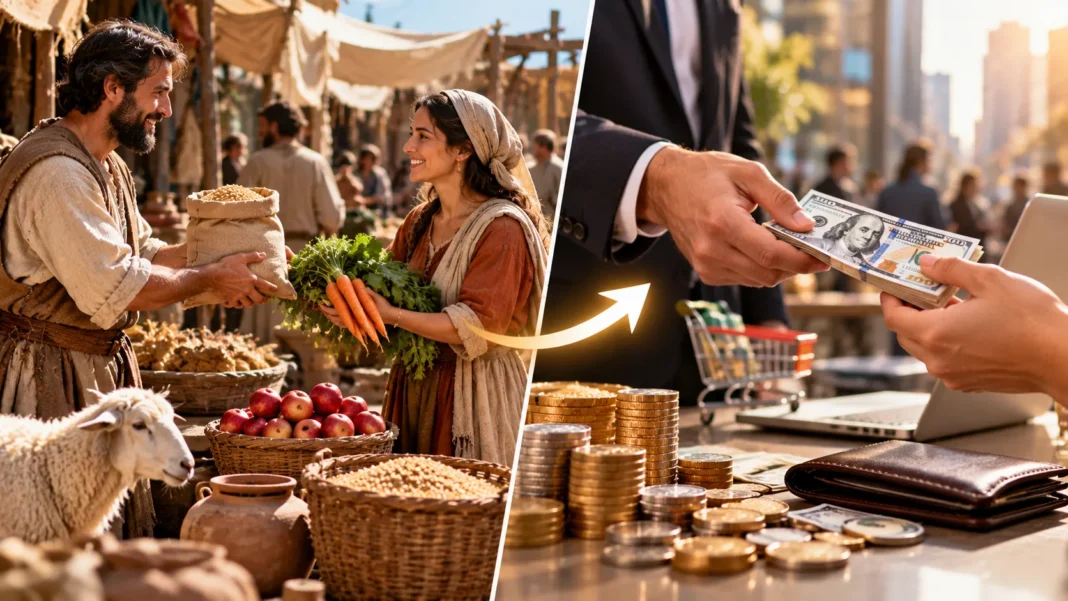

Before modern money became a common part of everyday life, people could exchange goods and services directly through a system known as bartering. A farmer might trade grain for clothing, while a craftsperson could exchange tools for food. Although this method allowed trade without cash, it created several practical challenges as communities and markets developed. Money became an important solution because it made buying, selling, saving, and comparing values easier. Understanding why the barter system was replaced by the use of money helps explain how modern economies developed and why currency plays such an important role in business and daily transactions.
What Is the Barter System?
The barter system is a method of exchanging goods or services directly without using money. Instead of paying a fixed price, two parties agree to trade items or activities they consider valuable. For example, someone may exchange vegetables for clothing or repair services. The exchange depends on both parties accepting the proposed arrangement.
Bartering has existed in different forms throughout human history. Communities have used direct exchange alongside gift-giving, credit arrangements, and other trading practices. However, historians do not generally consider a universal barter-only economy to be the established starting point of all money systems. Economic relationships have developed differently across societies.
Bartering remains possible today, especially in informal exchanges and certain business arrangements. People may trade skills, equipment, or unused goods without exchanging currency. However, barter can become inconvenient when the participants have different needs. These difficulties help explain why monetary systems became increasingly useful for trade.
How Did the Barter System Work?
The barter system worked through direct agreements between people who wanted to exchange goods or services. Each participant had something the other considered useful. They negotiated what would be exchanged and agreed on the relative value. Once both parties accepted the terms, the trade could take place.
For example, a farmer with extra wheat might want a pair of shoes. To complete a direct exchange, the farmer would need to find a shoemaker willing to accept wheat. The two people would then decide how much wheat should be exchanged. This process required agreement on both the items and their relative values.
Bartering could work well within familiar communities where people understood each other’s needs. However, it became more complicated when transactions involved unfamiliar goods or distant trading partners. Negotiating every exchange could require considerable effort. As markets expanded, more flexible methods of payment became increasingly valuable.
Why Was the Barter System Replaced by Money?
The barter system was gradually supplemented and often replaced by monetary exchange because direct trading had several limitations. People could struggle to find someone who wanted exactly what they offered. It was also difficult to compare the value of different products. Money helped reduce these problems by providing a commonly accepted means of payment.
Money allowed people to separate selling from buying. Instead of exchanging wheat directly for shoes, a farmer could sell wheat for money and later purchase shoes from another seller. The shoemaker did not need to want wheat. This flexibility made transactions easier across a wider variety of goods and services.
The development of money was not a single event that happened everywhere at the same time. Different societies used commodities, metal objects, coins, credit, and accounting systems in different combinations. Over time, widely accepted forms of payment became central to trade. Barter continued to exist, but money provided important practical advantages.
What Were the Main Problems of the Barter System?
One major limitation of bartering was the difficulty of matching the needs of two trading partners. A person might have valuable goods but be unable to find someone offering the desired product. This could delay transactions. Finding suitable exchange partners became increasingly challenging as trade expanded.
Another difficulty involved determining fair exchange values. Different people could disagree about how much one item was worth compared with another. The value of goods might also vary depending on supply, demand, and local conditions. Without a common pricing system, negotiations could become complicated.
Bartering also made saving, transporting, and dividing certain forms of wealth difficult. Perishable goods could spoil before they were exchanged, while large items were inconvenient to move. Some products could not easily be divided into smaller units. These problems encouraged the development of more flexible exchange arrangements.
The Problem of Double Coincidence of Wants
The double coincidence of wants is one of the most widely discussed limitations of direct barter. It occurs when two people must each possess something the other wants. Both needs must match for the exchange to happen. Without this agreement, a direct transaction may not be possible.
Imagine a baker who needs vegetables and has bread available for exchange. The baker must find a vegetable seller who also wants bread. If the vegetable seller prefers clothing, the exchange cannot happen directly. Finding another suitable partner may require additional time and effort.
Money reduces this problem because sellers can accept a common means of payment instead of needing the buyer’s goods. The baker can sell bread to one customer and purchase vegetables from another. Transactions no longer depend on matching two specific needs. This makes trade more convenient and flexible.
Why Was It Difficult to Measure Value in Barter?
Bartering made it difficult to establish consistent values for different goods and services. There was no universal unit for comparing the price of grain, clothing, livestock, and tools. Participants often had to negotiate separate exchange ratios. These negotiations could vary considerably between transactions.
For example, one trader might exchange several baskets of vegetables for a handmade tool. Another trader might demand a different quantity for the same tool. Differences in quality, availability, and demand could influence the agreement. Without standard prices, comparing offers became more difficult.
Money provides a common unit of account that allows people to express different values using the same measurement system. A business can price food, clothing, and equipment in the same currency. Customers can then compare alternatives more easily. This improvement supports clearer recordkeeping and economic planning.
Why Was the Barter System Unsuitable for Large Transactions?
Large transactions presented additional challenges under direct barter. High-value goods might require exchanging substantial quantities of other products. Transporting these goods could involve considerable time and expense. The participants also needed to agree on the relative value of everything involved.
For example, purchasing expensive equipment through barter might require several different products. A seller may not want all the items offered. Even if both parties agreed, arranging transportation and storage could be difficult. These practical problems limited the convenience of large exchanges.
Money made larger transactions easier by allowing value to be represented through standardized payment units. Buyers no longer needed to transport large quantities of unrelated goods to complete purchases. Financial records also became easier to organize. These advantages supported more complex commercial activities.
How Did the Lack of Divisibility Affect Barter?
Divisibility refers to the ability to separate something into smaller portions without destroying its usefulness or value. Some barter goods are easy to divide, such as grain or certain materials. Others are difficult to separate into practical units. This created problems when goods had very different values.
Imagine someone offering a cow in exchange for several small household items. The cow cannot be divided into smaller living animals while preserving the same product. The owner may struggle to arrange an exchange that provides the desired value. Similar problems can arise with equipment and other indivisible goods.
Money addresses this difficulty by providing smaller units for transactions. Coins and currency denominations allow people to pay different amounts without dividing physical products. Digital payment systems provide additional flexibility. This makes purchases easier when goods and services have very different prices.
Why Was Storing Wealth Difficult Under the Barter System?
Saving wealth through physical goods can create practical challenges. Some products lose quality over time, while others require substantial storage space. Food may spoil, livestock needs ongoing care, and equipment can deteriorate. These factors can reduce the usefulness of goods held for future exchange.
Bartering does not automatically prevent saving because people can store durable and valuable products. However, maintaining physical goods may involve costs and risks. Their future exchange value can also change. A person holding large quantities of one product may struggle to use that wealth when different needs arise.
Money can serve as a store of value when people trust its purchasing power. It is generally easier to hold and exchange than many bulky or perishable goods. However, money can also lose value through inflation. Its usefulness depends partly on economic stability and public confidence.
How Did Money Solve the Problems of Barter?
Money provided a generally accepted medium of exchange that reduced the need for direct product-for-product transactions. People could sell goods to one person and purchase different goods from another. This separated the two sides of trade. The result was a more flexible system for organizing economic activity.
Money also made prices easier to communicate and compare. Goods and services could be assigned monetary values rather than numerous exchange ratios. Businesses could calculate expenses, revenue, and profits more consistently. These features supported more organized commercial planning.
Another advantage was the ability to transfer purchasing power across time and distance. People could save money for later purchases or use it in different markets where accepted. Financial institutions eventually expanded these capabilities through deposits, credit, and payment services. Money therefore supported increasingly complex economic relationships.
What Are the Three Main Functions of Money?
Economists commonly describe three major functions of money: medium of exchange, unit of account, and store of value. Each function addresses an important aspect of economic activity. Together, they help explain why money became widely useful. Different forms of money may perform these functions with varying effectiveness.
As a medium of exchange, money allows people to purchase goods and services without offering another product directly. As a unit of account, it provides a shared measurement for prices and financial records. These features simplify trade and comparison. They also help businesses organize transactions.
As a store of value, money allows purchasing power to be held for future use. However, inflation and economic instability can reduce this ability. Money is most effective when users have reasonable confidence in its acceptance and value. These functions distinguish monetary exchange from direct barter.
How Did Commodity Money Develop?
Commodity money refers to goods that serve as money while also having value for other uses. Different societies have used commodities such as salt, grain, livestock-related products, and precious metals in monetary roles. The specific items varied according to local conditions. Their usefulness often depended on social acceptance and practical characteristics.
Certain commodities became useful in trade because people widely recognized their value. Durable and portable materials were especially convenient. However, commodity money still had limitations involving storage, quality, and divisibility. These challenges encouraged the development of more standardized payment systems.
Commodity money did not emerge through one identical historical process everywhere. Some societies used monetary commodities alongside credit arrangements and accounting records. Others developed different methods of exchange. Studying these systems reveals that the history of money is more complex than a simple replacement of barter.
Why Were Gold and Silver Used as Money?
Gold and silver became important monetary materials in many societies because they offered useful physical characteristics. They are relatively durable, recognizable, and divisible. Their scarcity also contributed to their perceived value. These features made them suitable for certain forms of payment and wealth storage.
Precious metals could be weighed and exchanged, but this process required checking their purity and quantity. Standardized metal coins helped simplify transactions by providing more recognizable monetary units. Governments and other authorities played important roles in issuing and regulating coinage. These systems developed differently across historical regions.
Gold and silver were not perfect forms of money. Their supply could fluctuate, and storing or transporting large amounts involved practical difficulties. Economic systems eventually developed other payment instruments. Nevertheless, precious metals played a significant role in the history of trade and monetary development.
How Did Coins Make Trade Easier?
Coins made transactions more convenient by providing standardized pieces of metal with recognized monetary values. Instead of weighing raw metal for every exchange, traders could use familiar denominations. This reduced some of the effort involved in payment. Coins also supported more consistent pricing.
The earliest known coinage traditions developed in different historical contexts, including ancient Lydia and neighboring regions. Coin use later spread through many parts of the world. However, not every society adopted coins at the same time. Other forms of money and credit continued alongside them.
Coins made small and medium-sized transactions easier when their value and authenticity were trusted. Different denominations supported purchases of varying amounts. Authorities often regulated their production and circulation. These developments helped create more organized monetary systems in growing commercial societies.
Why Was Paper Money Introduced?
Paper money developed as societies sought convenient alternatives to transporting large quantities of coins and precious metals. Early forms appeared in China, where paper-based monetary instruments became increasingly important. These systems evolved over time through commercial and government practices. Their development represented a significant change in monetary history.
Paper currency is generally lighter and easier to transport than equivalent values in metal coins. This makes it particularly useful for larger payments. It can also be produced in different denominations. However, its acceptance depends on confidence in the issuer and the broader monetary system.
Modern banknotes commonly function as fiat money, meaning their value is not based on a direct claim to a fixed quantity of precious metal. Instead, acceptance depends on legal arrangements, institutions, and public confidence. Central banks and monetary authorities manage important aspects of these systems. Paper currency remains widely used alongside electronic payments.
How Did Money Support the Growth of Trade?
Money supported trade by making it easier to exchange goods between people who did not share the same immediate needs. Merchants could sell products for a commonly accepted payment method. They could then purchase other goods elsewhere. This flexibility helped expand market opportunities.
Standardized prices also improved commercial communication. Buyers and sellers could compare products without negotiating completely different barter ratios. Businesses could maintain more consistent accounting records. These improvements supported larger markets and more specialized economic activities.
Money did not cause trade networks to develop entirely on its own. Transportation, legal institutions, communication, and political conditions also influenced commercial growth. However, monetary exchange became an important tool within these systems. It helped connect buyers, sellers, and markets across greater distances.
How Did Money Encourage Specialization of Work?
Specialization occurs when people or businesses focus on particular tasks or products. A worker may develop skills in farming, construction, teaching, or manufacturing. Money makes it easier to receive payment for these specialized services. Workers can then purchase goods they do not produce themselves.
In a direct barter arrangement, specialization can create challenges when trading partners do not want the worker’s specific service. A carpenter might need food from someone who has no immediate need for carpentry. Money reduces this difficulty. It allows the carpenter to receive payment from one customer and purchase food elsewhere.
Specialization can improve efficiency because people gain experience in particular activities. However, it also increases dependence on exchange networks. Money helps coordinate these relationships by providing a common payment system. This supports complex economies where most people produce only a small portion of what they consume.
What Role Did Money Play in Economic Development?
Money contributed to economic development by making transactions, accounting, and saving more convenient. Businesses could organize purchases and sales using common monetary units. Households could compare prices and plan future expenses. These capabilities helped support increasingly complex economic activities.
Monetary systems also developed alongside banking, credit, and financial institutions. These arrangements made it possible to transfer funds, finance business activity, and manage payments over time. However, credit and debt existed in various forms long before modern banking. Money evolved within broader economic and social systems.
Economic development depends on many factors beyond currency. Infrastructure, education, technology, institutions, and productive resources all influence growth. Money serves as an important tool for coordinating these activities. Its role is significant, but it should not be viewed as the only cause of modern economic progress.
Barter System vs. Money: Key Differences
Barter and monetary exchange both allow people to trade goods and services. Their main difference lies in how payment takes place. Bartering involves a direct exchange, while money provides an intermediate means of payment. This distinction influences convenience, pricing, and the organization of transactions.
| Feature | Barter System | Money System |
|---|---|---|
| Exchange method | Goods or services exchanged directly | Goods or services exchanged for money |
| Matching needs | Often requires matching wants | Does not require matching wants |
| Pricing | Negotiated exchange ratios | Common monetary prices |
| Divisibility | Depends on exchanged goods | Smaller monetary units available |
| Storage | May require storing physical goods | Can hold purchasing power in monetary form |
| Large transactions | Often less convenient | Generally more convenient |
| Recordkeeping | Multiple goods must be valued | Common accounting unit |
| Trade flexibility | Limited by suitable exchange partners | Broader exchange possibilities |
Money offers significant advantages in large and complex markets. However, barter can still be practical when people have matching needs and agree on an exchange. Neither system exists entirely independently of social relationships and trust. Their usefulness depends on the circumstances.
Does the Barter System Still Exist Today?
Yes, bartering continues to exist in modern economies. Individuals sometimes exchange used goods, professional services, or practical assistance without using money. Businesses may also arrange barter agreements involving advertising, equipment, or other services. These transactions can be useful when both parties have compatible needs.
For example, a graphic designer might provide design services in exchange for photography work. Both participants can benefit if they value the services being offered. However, they must still agree on expectations, quality, and relative value. Clear communication helps prevent misunderstandings.
Modern barter arrangements may also involve tax or accounting obligations depending on local laws. A noncash exchange is not necessarily exempt from financial reporting requirements. Businesses should understand the rules governing their transactions. Bartering remains useful in selected situations but does not replace the flexibility of money.
What Are the Advantages of the Barter System?
One advantage of barter is that it allows exchanges without requiring cash at the time of the transaction. People who have useful goods or skills can trade directly with others. This may be convenient in informal arrangements. It can also help unused resources find new purposes.
Bartering may support cooperation within communities where people understand each other’s needs. Exchanging services can create mutually beneficial arrangements. However, the success of the transaction depends on clear agreements and suitable exchange values. Trust and communication remain important.
Another advantage is that barter can encourage the reuse of goods. Instead of leaving an item unused, its owner may exchange it for something more useful. This can reduce unnecessary purchases in certain circumstances. However, barter is not automatically more efficient or environmentally beneficial in every situation.
What Are the Disadvantages of the Barter System?
The main disadvantage of barter is the difficulty of finding someone who wants exactly what another person offers. This matching problem can make transactions slow or impossible. The challenge becomes greater when people trade specialized goods. Money reduces the need for such direct matching.
Another limitation is the lack of a common measure of value. Participants may disagree about the appropriate quantity or quality of goods to exchange. Complex transactions can require lengthy negotiations. This creates uncertainty and increases the effort needed to complete trade.
Storage, transportation, and divisibility can also create problems. Perishable goods may spoil, while large products can be difficult to move. Some items cannot be divided into smaller portions without reducing their usefulness. These limitations make barter less convenient for many modern commercial activities.
Why Is Money More Convenient Than Bartering?
Money is more convenient because it provides a widely accepted way to complete transactions. Buyers do not need to offer goods that sellers personally want. Instead, they can pay using a common monetary instrument. This makes exchanges easier across many different markets.
Money also simplifies comparing prices. A customer can evaluate several products using the same currency instead of calculating multiple barter ratios. Businesses can prepare invoices, budgets, and financial reports. These advantages support more efficient decision-making.
Digital payments have increased the convenience of monetary exchange even further. People can transfer funds electronically without physically transporting cash. However, these systems also depend on infrastructure, security, and reliable institutions. Money’s convenience comes from both its economic functions and the systems supporting its use.
How Did Digital Money Change Modern Trade?
Digital money allows monetary value to be transferred through electronic systems. Bank transfers, payment cards, and mobile wallets are common examples of digital payment methods. These tools help people make transactions without exchanging physical currency. Their availability has changed how many businesses operate.
Online shopping is one area where digital payments play a major role. Customers can purchase products from businesses located in different regions. Electronic records also make transactions easier to track. These capabilities support modern commercial networks and digital services.
Digital payments are not without limitations. Users may face transaction fees, technical failures, fraud risks, or restricted access to financial services. Privacy and cybersecurity are also important concerns. Reliable payment systems require suitable technology, regulation, and consumer protection.
Is Bartering Better Than Using Money?
Bartering can be useful when two parties have goods or services that meet each other’s needs. It may work well for small exchanges or community arrangements. However, it becomes less convenient when transactions involve many participants. The need to match wants remains a significant limitation.
Money generally provides greater flexibility in larger markets. It allows buyers and sellers to separate transactions, compare prices, and maintain financial records. These features make trade easier for most everyday commercial activities. Monetary systems therefore dominate modern economies.
The best exchange method depends on the circumstances. A simple trade between two individuals may work perfectly well without money. A complex business transaction usually benefits from standardized payment. Understanding both systems helps explain their different roles in economic life.
What Can We Learn From the History of Barter and Money?
The history of barter and money shows how societies develop different methods to organize exchange. People have used direct trades, credit relationships, valuable commodities, coins, and other payment arrangements. These systems often existed together rather than following one universal sequence. Their development reflects changing social and economic needs.
Money became important because it offered solutions to several limitations of direct barter. It provided a common measure of value and made transactions more flexible. These advantages supported trade between individuals with different needs. Monetary systems also developed alongside expanding institutions and commercial networks.
Studying this history helps explain why trust remains central to economic exchange. Whether payment involves goods, coins, paper currency, or electronic records, participants need confidence that an agreement will be honored. The form of payment may change, but reliable exchange relationships remain essential.
Conclusion
The barter system was gradually replaced or supplemented by money because direct exchanges created practical difficulties. Matching the needs of trading partners, measuring value, dividing goods, and storing wealth could be challenging. Money offered a more flexible way to complete transactions without requiring both parties to want each other’s products.
Money also supported the growth of trade, specialization, recordkeeping, and increasingly complex economic activity. Its functions as a medium of exchange, unit of account, and store of value made it useful across many different situations. Over time, societies developed commodities, coins, banknotes, and electronic payment systems to meet changing needs.
Although bartering still exists today, money provides greater convenience for most modern transactions. Understanding the differences between these systems helps explain how exchange methods developed throughout history. The transition was not a single worldwide event, but part of a broader evolution in commerce, institutions, and economic relationships.
Frequently Asked Questions
Why was the barter system replaced by the use of money?
Money reduced major barter difficulties, including matching trading partners’ needs, comparing values, dividing goods, and storing wealth. It made transactions more flexible and supported larger, more complex markets.
What was the biggest problem with the barter system?
The double coincidence of wants was a major limitation. Two people needed to want each other’s goods or services at the same time, making direct exchange difficult.
What are the three main functions of money?
The three main functions of money are medium of exchange, unit of account, and store of value. These functions help people trade, compare prices, and preserve purchasing power.
Does the barter system still exist today?
Yes, bartering continues through exchanges of goods and services between individuals and businesses. However, money remains more convenient for most transactions because it does not require directly matching needs.
Was money invented immediately after the barter system?
No, monetary systems developed gradually through different historical processes. Societies used direct exchange, credit, commodity money, coins, and accounting arrangements in overlapping ways rather than following one universal sequence.